Stop Copying Competitors: Why Retailers Win When They Test with Shoppers Instead
When a competitor gains traction from an expanded shelf set or new category strategy, the instinct is familiar: Do something similar, fast.
In retail, copying competitors can feel like the safe move, but mimicking what another retailer or brand has done isn’t the same as understanding why it worked — or whether it would work for your shoppers.
That’s the problem.
A competitor’s retail environment may be completely different from yours: Different store formats, different shopper base and price perception, different brand equity. What drives attention and purchase in their stores may fall flat in yours.
And by the time you copy their move, you’re already reacting to yesterday’s strategy — and you’re certainly not leading the charge.
That’s why retailers and brands that test with actual shoppers outperform those that rely on competitor mimicry. They don’t just observe the market; they validate what actually drives engagement and purchase with their own shoppers.
Using these shopper insights, they uncover their edge on competitors and discover which changes are worth implementing before mass rollout.
Instead of doing the bare minimum and benchmarking the market, the most successful retailers are proactive and learn from the people who actually buy from them.
Competitor Benchmarking is Useful — Until It Becomes the Entire Strategy
Competitive research has value. Retailers should understand competitor assortments, pricing, promotions, store concepts, and category tactics.
However, competitor observation becomes a problem when it turns into imitation. Seeing that another retailer moved a subcategory or changed a fixture strategy doesn’t tell you if the move improved shopability or conversion. It only tells you that something changed.
That’s the difference between monitoring the market and understanding your shoppers. These tactics may look strong from the outside, but you can’t see whether shoppers noticed the change, whether it created friction, or whether it actually influenced purchase.
Because of those blind spots, strategic mimicry is a lot riskier than it seems.
Copying Competitors Means Copying Without Context
Retailers often copy competitors because the move feels lower-risk than going first, but visibility does not equate to proof.
The new concept seems like it has momentum, but did it lift sales? Did it create execution issues? Is a replacement already being planned?
You don’t know. What looks like validation is often just incomplete information.
That’s why copying competitor strategies often leads to wasted effort. A borrowed layout may disrupt the store flow that your shoppers rely on. A borrowed assortment optimization strategy can reduce the visibility of key items.
High-performing retailers don’t stop at comp shopping. They move from observation to validation.
What Shopper Testing Reveals that Competitor Copycatting Never Can
Retailers that test with shoppers do something very different: They measure response before rollout.
Instead of assuming a competitor’s tactic will work in their stores, they test how their own shoppers react to similar layouts, assortments, placements, and concepts. That helps answer the questions that actually matter:
- Does this change help shoppers find products faster?
- Does it increase attention to priority items?
- Does it improve the flow of the aisle?
- Does it support the shopper’s mission?
- Does it influence purchase behavior enough to justify rollout?
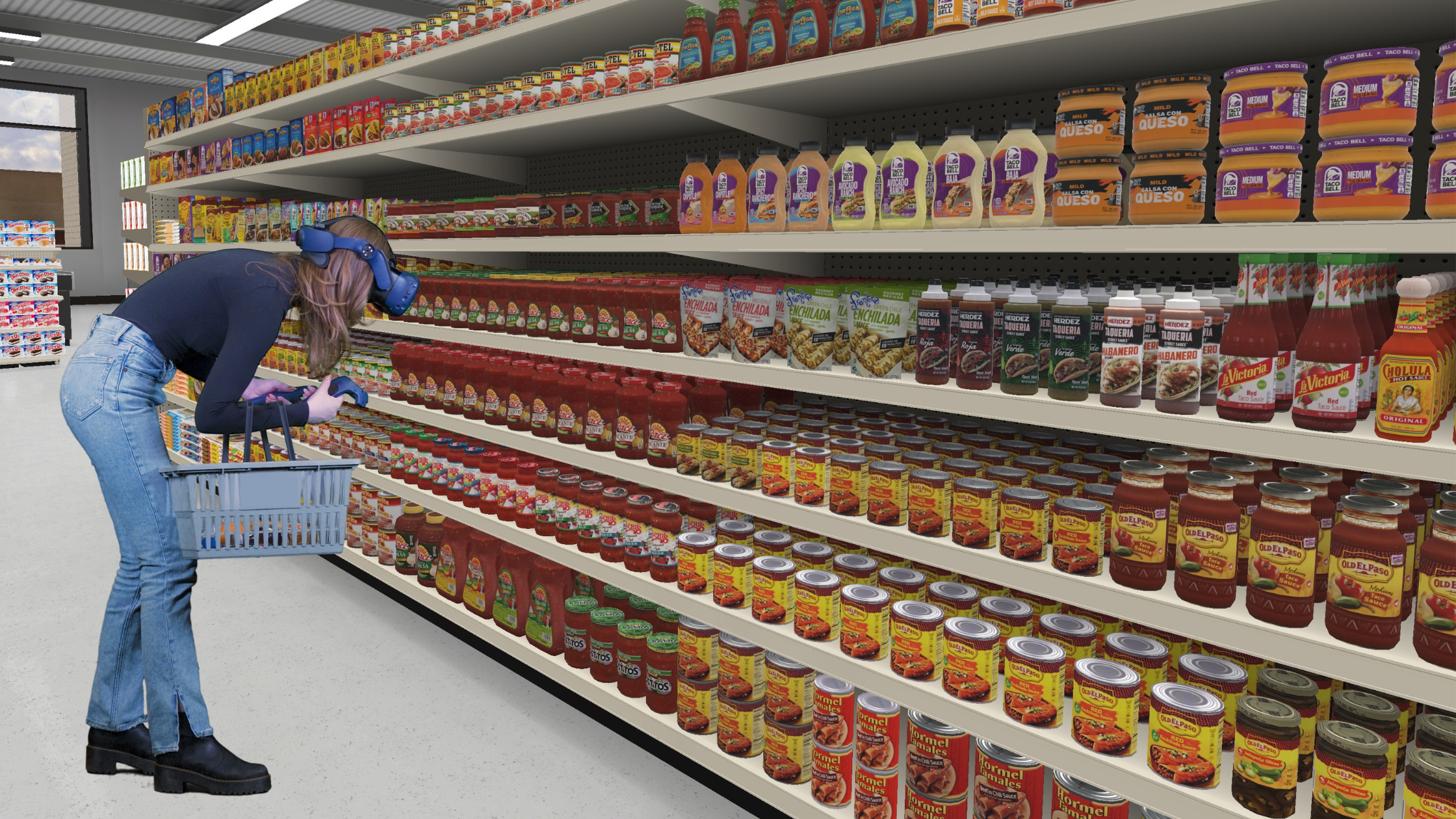
Virtual benchmarking and shopper testing make those answers easier to find. Teams can compare their own concepts against competitor-like layouts, spot where attention drops, and understand what actually drives purchase, not just what looks current in the market.
The Best Retailers Benchmark Competitors — Then Test Beyond Them
The strongest retail teams use competitive benchmarking to generate hypotheses. For example, did a rival’s category flow reduce friction?
Then, they test those ideas with shoppers instead of importing them blindly. In the example, a retailer could run an A/B virtual aisle test. They can ask actual customers to complete realistic missions in two store environments: The current flow and a replica of the rival’s flow.
In these virtual store environments, the retailer can compare objective metrics like time to find items, navigation errors, path length, and abandonment to determine whether the rival layout measurably reduces friction.
If so, they can safely implement a similar strategy in their stores, because they have the data to prove its efficacy.
Virtual shopper research helps reveal whether the idea actually works for your shoppers and where competitors may be missing opportunities.
Why Virtual Shopper Testing Outperforms Mimicry Strategies
The shift toward shopper-led experimentation reflects a broader trend across industries. 62% of organizations say they rely heavily on research insights to guide decisions, and 87% of qualitative research is now conducted online or remotely.
For retailers, that shift is accelerating the move toward faster, scalable ways to test concepts with real shoppers before rollout.
It replaces assumptions with evidence.
Competitor-inspired decisions are still assumptions until they’re validated. Shopper testing gives teams stronger evidence before they ask stores to execute — and stronger arguments when they need to defend decisions internally.
It explains why something works.
A competitor tactic may look effective, but appearance is not proof. Shopper testing reveals what draws attention, where friction appears, and what influences choice. That understanding improves the next decision, not just the current one.
It reduces the cost of chasing the wrong idea.
Reacting to competitors without validation wastes time, budget, and labor. Shopper testing helps filter ideas earlier, before a weak concept turns into an expensive reset or rollout.
Check out how one condiment manufacturer tested signage concepts and assortment combinations with target consumers to identify a winning campaign that improved sell-through by 6%.
It creates differentiation.
Copying competitors may help a retailer keep up, but it rarely helps them stand out. Virtual reality market research helps teams build experiences that are more intuitive, more distinctive, and harder to replicate.
It builds a learning advantage.
Copying is reactive, but testing is cumulative. Every shopper test adds to the organization’s understanding of what actually works — by shopper, category, format, and campaign. Over time, that becomes a competitive advantage that no one can copy.
Conclusion
Want to see how immersive technology is helping retailers and brands move from competitor copying to shopper-backed decision-making?
Download How VR Is Transforming Visual Merchandising to explore how leading teams are using virtual reality to test and validate better store experiences before anything reaches the physical shelf.