The Future of In-Store Experience: Agile Visual Merchandising, Faster Execution, and Real Store Impact
NRF 2026: Retail’s Big Show felt more like Retail’s Big AI Show, but the most valuable conversations weren’t about agents or dashboards. They were about whether or not teams can actually use these tools come Monday morning. Thread Advisory Group captured the shift best: “AI isn’t the headline anymore — execution is.”
That framing matches what we heard again and again on the show floor: The future of in-store experience is being shaped less by any single buzzword and more by a new operating mandate: Agility.
Retailers are prioritizing speed and adaptability, powered by better visualization, execution in workflows, and shorter cycle times from idea to reality.
If NRF left you wondering what actually matters for in-store experience, here are three frameworks that will still apply when the buzzwords change.
In-Store Experience Will Win in Design (But Only if it’s Designed in Context)
For years, “experiential retail” has been treated like a creative conversation. “Use the store as theater, brand as a moment, fixtures as storytelling.”
NRF 2026 pulled back the metaphorical curtain to something more practical: The in-store shopping experience lives or dies in the physical constraints you don’t see in 2D.
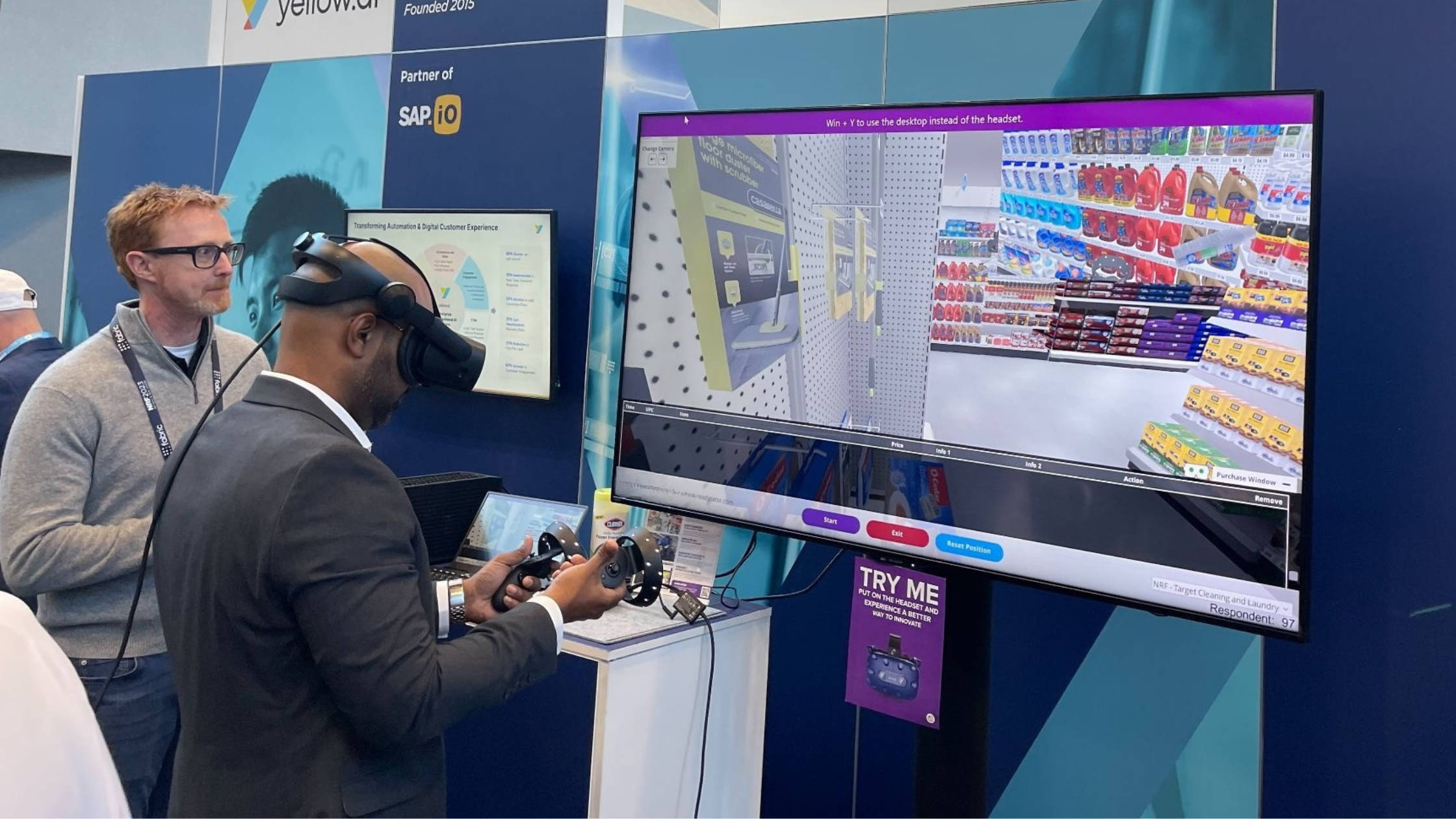
One of the most visceral examples we saw came from our interactive Studio demo. A few people of shorter stature couldn’t physically reach an overhead faucet in the virtual store. On paper, the design looked fine. In 3D, the problem was immediately obvious — and, better yet, immediately fixable.
That’s the point. The “wow” factor of high-fidelity visualization isn’t just entertainment anymore. It offers real ROI in risk reduction and better customer experiences. Retailers and brands can use immersive store planning to:
- Pressure-test how the store layout and design feel at the human scale
- Catch accessibility and ergonomics issues before rollout
- Align cross-functional teams on what “good” actually looks like
Retailers are connecting the dots. The in-store experience isn’t just what customers feel; it’s what merchandising teams can confidently build and scale. More and more, teams want to see decisions play out visually, in real space, before anything hits the floor.
Interested in a personalized demo of our 3D and VR store planning feature, Studio? Click here.
Store Execution is Finally Being Treated as a Strategic Advantage
NRF is where the future gets staged. Stores are where it gets stress-tested. If an innovation doesn’t reduce the messy, manual, end-of-day reality for retail teams, it doesn’t matter how impressive the demo looks.
The same disconnect plays out every day inside retail organizations. HQ unveils a polished, “perfect” campaign, and stores receive… a static PDF. What looked seamless in a boardroom — or on a show floor — quickly breaks down when it meets the complexity of real store conditions.
On the Javits Center floor, we saw how quickly that gap closes when execution lives where the work actually happens: On a device, in context, with visuals that associates can interact with.
When store teams can tap, zoom, and understand intent directly, plans stop being aspirational and start becoming executable.
As a result, store execution is finally being treated as a competitive advantage, not an afterthought. Retailers are demanding:
- Directions that are clear enough to execute
- Less room for interpretation and human error
- Fewer delays caused by back-and-forth communication
- Faster time-to-floor
In 2026, the best experience isn’t the flashiest concept. It’s the one that stores can execute consistently, correctly, and quickly.
Agility is the Core Mandate, and Cycle Time is the Bottleneck Retailers Can’t Ignore
Our CEO’s LinkedIn recap captured the most important anti-buzzword truth of NRF 2026: “The biggest takeaway for visual merchandising and retail execution wasn’t agentic AI. It was the re-emergence of agility as the core mandate.”
Retailers can launch online in days. In-store launches still take weeks or months due to disconnected data, siloed teams, and sequential handoffs. That mismatch is becoming unsustainable, especially as younger shoppers place greater value on localized, relevant in-store experiences.
We heard the downstream impact directly: Retailers are often forced to lock assortments months (sometimes a full year) in advance, simply because store execution cycles are too slow.
The opportunity lies in shortened cycle time end-to-end, from concept to compliance, so retailers can stay on trend without betting a year ahead.
In his featured session, Macy’s chief customer and digital officer, Max Magni, captured the tension perfectly: “AI moves faster than the organizational readiness.”
The subtext is clear. The bottleneck isn’t technology. It’s the time and coordination required to turn a visual merchandising decision into a store reality.
Unified systems are table stakes. NRF’s sharper signal was context: Information delivered in the right format, at the right moment, for the real conditions of the store. That’s why “designing for how work actually happens” and “connecting planning to execution” surfaced repeatedly in the most grounded conversations.
When Expectations Are Set Earlier, Execution Matters More Than Ever
Urgency is also increasing as decision-making moves earlier in the shopper journey, often before a customer ever steps into a store.
At NRF, one of the more nuanced offstage conversations wasn’t about AI replacing visual merchandisers or stores, but about where expectations are now being set. As shoppers increasingly use AI-driven tools to explore products, styles, and trends, they’re forming opinions faster and arriving in stores with clearer intent.
Retail Dive surfaced the underlying concern: When discovery and decision-making happen outside a retailer’s direct control, brands risk losing visibility into how expectations were formed — and what stores are being asked to deliver against.
As Aptos’ Nikki Baird put it, “The retailer loses so much context.”
For physical retail, that’s an execution problem. When expectations are set upstream, stores have far less margin for error. Fixtures must be right. Assortments must feel current. Execution must be consistent across locations.
Store teams need clarity, not interpretation, when bringing concepts to life. That’s why agility inside the store environment matters more than ever.
As external signals accelerate, retailers can’t afford slow, fragmented processes that delay resets, lock assortments in too early, or dilute intent by the time it hits the floor.
The big takeaway? In-store experiences aren’t competing with AI-driven discovery. They’re being asked to deliver on it, faster and with more precision than ever before.
If It’s Not “Just About AI,” What Is It About?
NRF 2026 matured the AI conversation, shifting the focus from experimentation to implementation. The throughline was simple: Visualize at a human scale, execute in the flow of work, and compress cycle time to keep pace with customers and culture. That’s the future of in-store experience, not louder tech but better moves.
At One Door, we care less about what looks impressive on a stage and more about what helps teams translate vision into store reality. Learn more about Store Assistant, our AI-powered retail execution platform designed to help store teams execute with clarity — not complexity.