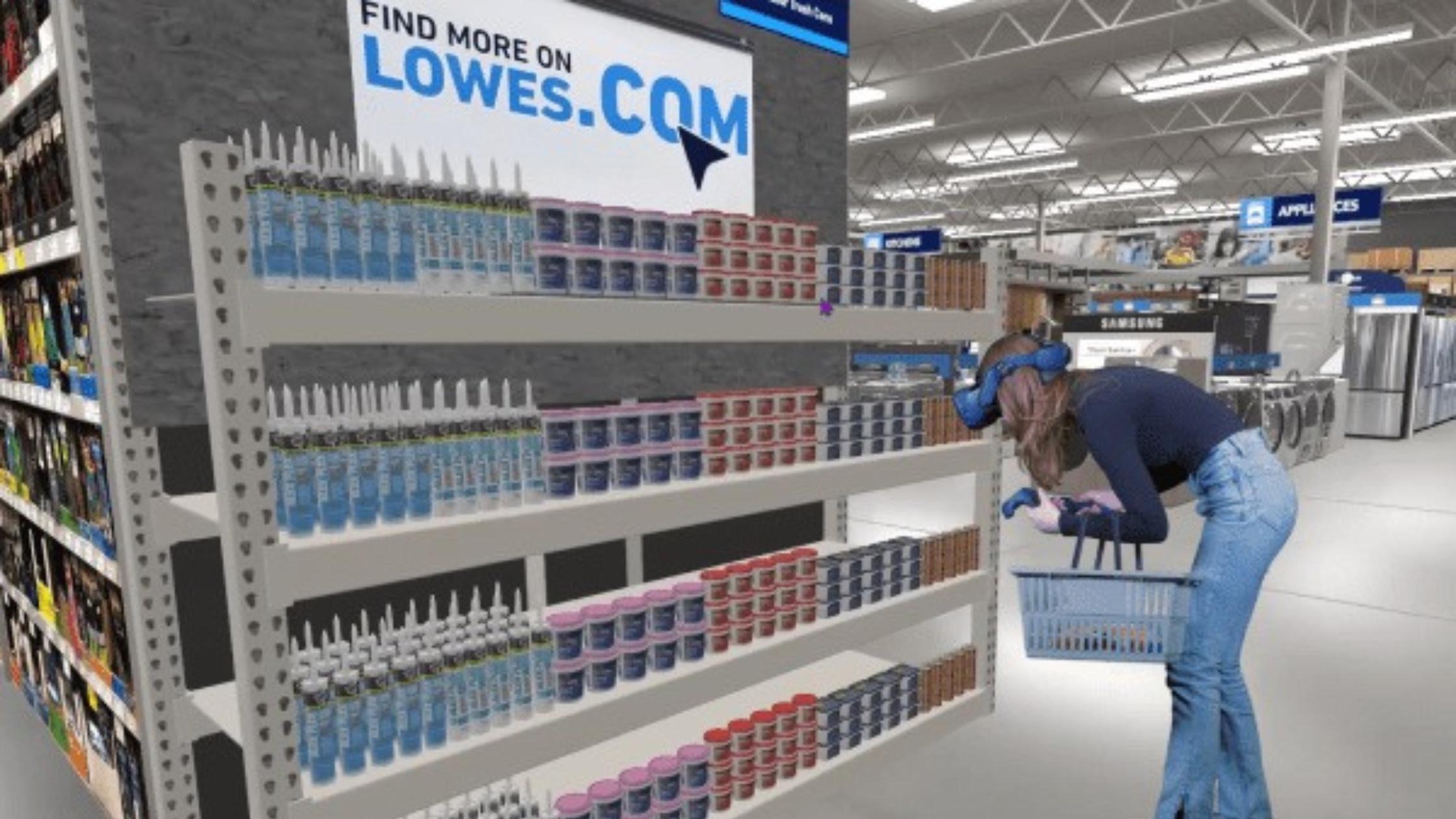
How VR Helps Retail Teams Design Smarter, Train Faster, and Understand Shoppers Better
Virtual reality (VR) may feel like a modern innovation, but its roots stretch back nearly two centuries.
Early 3D viewing devices emerged in the 1830s, and by 1968, Ivan Sutherland’s “Sword of Damocles” became the first true VR headset — an immersive, computer-generated environment that responded to head movement.
What began as experimental simulation technology has evolved into one of today’s most practical tools for brands and retailers. VR now helps teams design stores, iterate ideas, understand shoppers, and train associates in ways that weren’t possible even a few decades ago.
VR allows today’s retail era to move with clarity and confidence across every stage of store planning and execution. Here’s how virtual reality is reshaping the way retail teams work today.
Prototype Store Concepts & Displays Before They Exist
No need to rely on flat planograms or costly physical mockups anymore. Virtual reality gives retail teams the ability to create and explore fully realized store concepts digitally.
Whether they’re planning a new store format, testing a seasonal aisle, optimizing a display, or concepting a brand zone, immersive 3D and VR environments help teams:
- Walk through layouts at life-size scale
- Evaluate shelf sightlines, adjacencies, and aisle navigation
- Experiment with fixtures, signage, and content
- Compare and contrast alternatives quickly
This virtual-first approach enables retailers to test ideas early, collaborate more easily across job functions, and build confidence before committing financial resources. It also removes real-world constraints, such as inventory, space, and production lead times, allowing teams to think more creatively and iterate faster.
Real-World Example: A major financial services provider saved $4.5 million in potential redesigns by concepting and testing pilot branches before construction. Read more here.
Run Shopper Research in Virtual Store Labs
One of retail’s biggest challenges has always been understanding how shoppers actually behave. VR gives teams a way to observe realistic consumer behavior without the expense of in-person focus groups or the limitations of traditional digital surveys.
With virtual reality market research, retailers and brands can:
- Test new layouts, signage, or displays in context
- Measure attention using eye tracking heatmaps
- Observe navigation paths and dwell times
- Conduct quantitative or qualitative studies online or through a headset
Because respondents interact with a lifelike store — walking aisles, selecting products, and making purchasing decisions in real-time — retailers gain shopper insights that feel closer to in-store behavior. This makes early-stage merchandising decisions stronger, faster, and more grounded in evidence.
Real-World Example: A global healthcare company optimized its allergy planogram using 3D design, data analysis, and shopper research to achieve 60% cost savings. Read their story here.
Train Store Associates Through Immersive Simulation
Retailers have long relied on heavy manuals, old brand videos, and sporadic shadowing to train associates. Unfortunately, these methods often fall short of preparing teams for real-life complexity on the sales floor.
Virtual reality employee training can offer a more hands-on, consistent way to build skills and confidence in store teams. Through immersive simulations, associates can:
- Practice setting displays, stocking routines, and core operations
- Explore new equipment or procedures before they’re rolled out across stores
- Experience customer interactions in a safe, low-stakes environment
- Prepare for rare or high-stress scenarios, like emergencies or crowd surges
VR can help reduce onboarding time while improving knowledge retention, and because every associate can access the same realistic training environment, retailers can drive more consistent execution across locations.
Real-World Example: In 2018, “Walmart introduced VR to the world of employee training and development by using the technology to upgrade training at Walmart Academies nationwide.
With the huge success of that program, the company [provided]…headsets to all stores in the U.S. to bring the same level of training to more than 1 million Walmart associates.”
Enhance Shopper and Partner Engagement with Immersive Experiences
VR is also changing how teams communicate with external partners, cross-collaborate with internal stakeholders, and how shoppers discover products.
For Retail Partners and Internal Teams
Virtual store environments can serve as powerful storytelling tools during line reviews, seasonal walkthroughs, or cross-functional presentations. Instead of relying on slide decks, teams can step into a life-size aisle, compare 3D concepts, or preview new packaging in context.
Real-World Example: An over-the-counter manufacturer used 3D retail presentations to captivate a major retailer, setting a new standard for partner relationships and engagement. Read their customer spotlight.
For Shoppers
Brands and retailers are experimenting with VR to create richer product experiences, from virtual showrooms to in-store or at-home try-ons. These virtual experiences help shoppers visualize fit, scale, and placement in ways traditional visual merchandising can’t.
Real-World Example: MUJI, a furniture brand in Helsinki, used VR in-store headsets to immerse shoppers in a calming Finnish landscape while they relaxed on one of the brand’s beds. The experience helped customers feel the product’s value firsthand and differentiated the brand through an emotional, memorable interaction.
Across both audiences, immersive environments make ideas more memorable, interactive, and actionable.
Why VR is Becoming a Retail Essential
Whether used for design, data, training, or shopper engagement, VR brings a level of clarity and confidence that traditional visual merchandising strategies can’t match. It helps teams:
- Move faster with fewer physical constraints
- Reduce costly trial-and-error
- Collaborate more effectively across locations and job functions
- Understand shoppers earlier in the process
- Translate ideas into reality with far less ambiguity
As immersive technologies continue to evolve, virtual reality is becoming one of the most versatile tools for building better retail experiences. Download our 2026 VR in Visual Merchandising Guide to get the latest on virtual reality’s future in retail.