Why Retailers Are Replacing Physical Store Pilots with Virtual Shopper Research for Retail Experimentation
Retailers and brands still believe in piloting ideas. They just no longer believe every test belongs in a physical store.
For decades, live-store pilots have been the standard way to test new layouts, category resets, promotions, signage, and assortment changes.
If a team wanted to know whether a concept would improve conversion or engagement, they selected a set of stores, built the test, and waited for results.
That model is starting to break. Physical pilots are expensive, slow, and difficult to control.
They depend on store labor, consistent execution, inventory coordination, and clean test conditions that rarely exist in the real world.
Even when a concept is strong, results can be distorted by traffic shifts, staffing variability, stock issues, or local market noise.
That’s why more retailers and brands are moving from physical retail pilot testing to virtual shopper research.
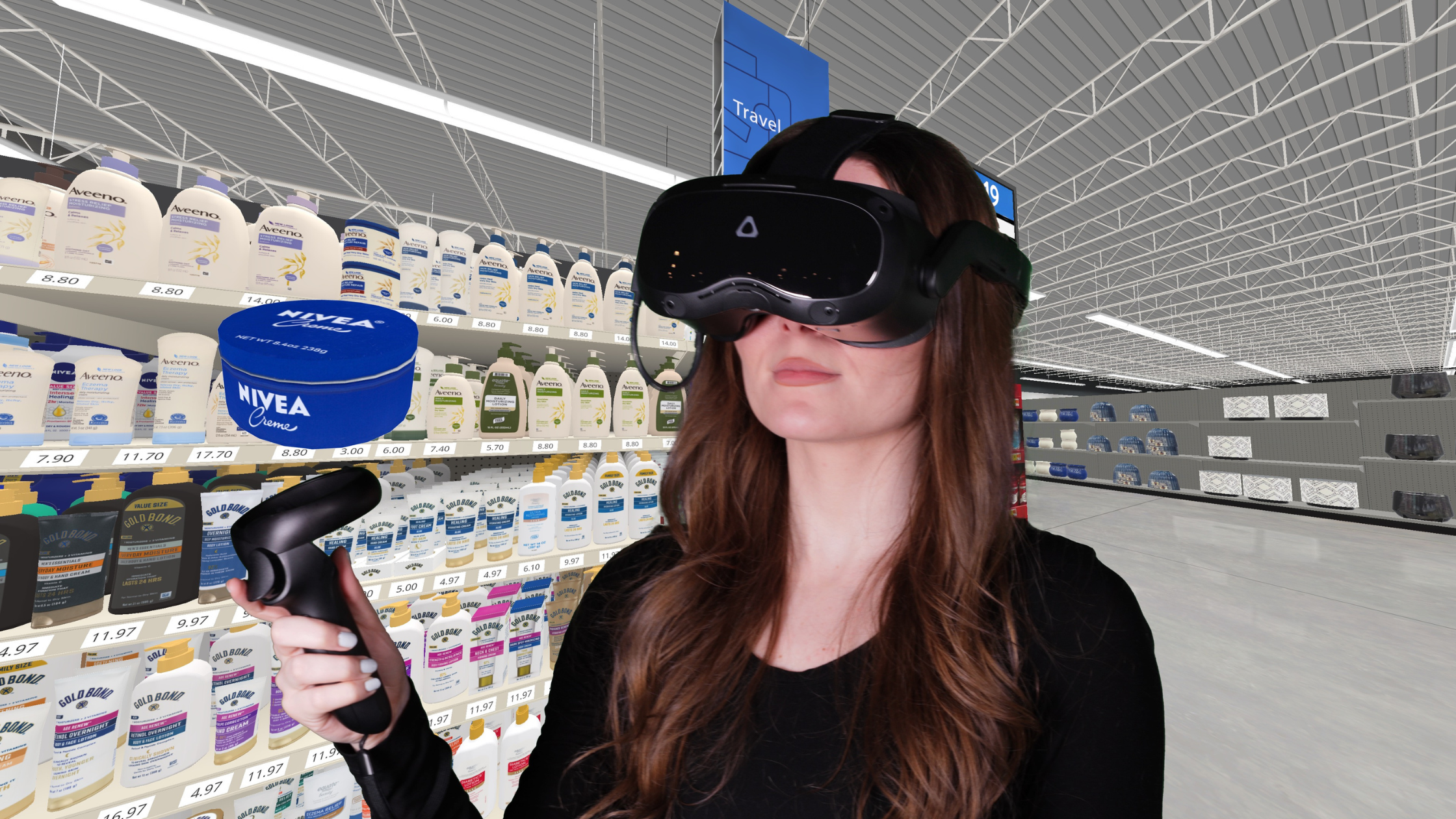
Instead of asking stores to absorb every early experiment (or worse, building a demo store from the ground up), they’re using virtual environments to test ideas, compare concepts, and understand shopper behavior before making a real-world investment.
The results are faster learning, lower financial risk, and more confidence in what finally moves into physical stores.
The Problem: Physical Pilots Were Built for a Slower Retail Era
The logic behind traditional pilots is still sound: Test before you scale.
The problem is that retail organizations now need to test more ideas, more often, and with greater precision. CPGs want to pressure-test assortment and adjacency decisions before product presentations.
Data teams want stronger evidence around shopper behavior and attention. Store design leaders want to refine layouts before construction or reset. Operations leaders want fewer half-formed concepts pushed into the field.
A physical pilot can answer some of those questions, but it does so at a high cost. A live-store test often requires:
- Test and control store selection, or building a demo store from scratch
- Fixture or signage changes
- Inventory moves
- Store training and execution support
- Selling time
- Post-test analysis
By the time the readout is ready, multiple teams have already invested significant time, labor, and budget. Because each physical pilot is so resource-intensive, retail organizations often test fewer ideas than they should, creating a bottleneck in innovation.
The Solution: Virtual Shopper Testing Changes the Economics of Experimentation
Virtual shopper testing gives retailers and brands a way to evaluate concepts before they commit to live-store execution.
In a virtual environment, teams can simulate a store, aisle, fixture, shelf, or concept and expose shoppers to realistic experiences that mirror in-store decision-making. Researchers can then measure:
- How shoppers navigate
- What they notice
- Where they hesitate
- Which products they select
- How they respond to different merchandising variables
That makes it possible to answer questions like:
Will this layout improve product discovery?
Does this signage help shoppers find the offer faster?
Will this adjacency encourage cross-category purchasing?
How does a revised assortment change preference or substitution behavior?
Which concept deserves a real-world pilot, and which should stop here?
This is why virtual shopper testing is replacing more early-stage pilot work. It lets teams learn earlier, compare more options, and avoid pushing weak ideas into stores.
The Why: More Retailers and Brands are Making the Shift
Retailers and brands are moving away from physical pilots because virtual shopper testing solves several of the biggest problems that make traditional pilots slow, costly, and difficult to scale.
They need faster answers.
One of the biggest problems with physical pilots is the cycle time. Traditional store pilots can take 6-12 months to complete, while virtual shopper testing cycles often deliver results in under eight weeks.
When a test takes months to set up, run, and analyze, the retail business loses momentum. Category reviews move on. Seasonal windows close. Leadership attention shifts.
What should be an agile experiment becomes a slow decision cycle. Fortunately, virtual shopper research compresses that cycle. Teams can evaluate multiple concepts quickly, narrow down to the strongest options, and move forward with better evidence.
For shopper insights, merchandising, and innovation leaders, that speed is strategic. It increases the number of decisions the organization can make with confidence in a given quarter.
They want cleaner, more reliable learning.
In a live store, too many variables cannot fully be controlled, from traffic and weather conditions to out-of-stocks and competitor promotions.
These variables make physical pilots noisy, but virtual shopper research creates a more controlled environment for retail experimentation.
Teams can hold more conditions constant and isolate the impact of the variable they’re actually testing. This gives stakeholders a cleaner read on what’s worth investing in moving forward.
For a major financial services provider, pre-construction testing reduced the financial risk of ineffective elements from originally planned pilots, saving $4.5M in potential redesigns. Read more.
They cannot afford to treat stores like laboratories.
Every live pilot places demands on the field. Store associates have to implement the changes. Operations leaders must monitor consistency. Merchandising and insights teams have to coordinate execution and analysis.
During busy periods, that burden becomes even harder to justify. Virtual testing supports those priorities by reducing how much early experimentation has to flow through live stores.
They need more than lagging sales data.
Sales data can tell you what happened. Unfortunately, it does not always explain why.
Virtual shopper research provides a richer understanding of consumer behavior by revealing how shoppers move through a space, what gets noticed or ignored, and where decision-making stalls.
That’s especially valuable for teams responsible for merchandising and store layout testing, because they’re asking, “Did shoppers see this? Could they find it? Did the flow make sense? Was the experience easier to shop?”
The How: Where Virtual Shopper Testing Creates the Most Value
Retailers and brands are seeing the most value when they apply virtual testing to decisions that are expensive to get wrong:
- Store layout testing. Teams can compare different aisle flows, adjacencies, or fixture configurations before a reset, remodel, or pilot.
- Merchandising testing. Category managers and shopper insights teams can assess product arrangement, shelf composition, seasonal sets, and promotional placements before asking stores to execute them.
- Planogram and assortment optimization. Brands and retailers can evaluate whether new configurations improve navigation, visibility, and purchase behavior.
- New concept and format validation. Design and innovation teams can test if a new environment works before committing to construction or rollout budget.
The Nuance: Virtual Testing Should Not Eliminate Physical Pilots
To be clear: Virtual shopper testing should not replace the physical store pilot entirely. It should replace a large share of the early, expensive, low-efficiency pilot work that used to happen there.
That’s a major difference. Retailers still need live validation for some variables, such as labor impact, replenishment realities, execution consistency, and the messiness of real-world operating conditions.
Physical environments will likely always play a role in that final validation, but most retail organizations don’t need to run every early concept through a live store to find out if it deserves serious consideration.
The smarter model is staged:
- Use virtual shopper testing to screen, compare, and refine ideas first.
- Use physical pilots more selectively for the few concepts that warrant operational validation.
- Scale with more confidence.
This approach makes physical pilots more valuable, not less, because it reserves them for the concepts most worth proving in the market.
The Conclusion: A Smarter Model for Retail Experimentation
Virtual shopper testing is a smarter way to make retail decisions. By moving more experimentation upstream:
- Retailers can reduce the cost of bad ideas, accelerate learning, and give cross-functional teams stronger evidence before mass rollout.
- Shopper insights leaders gain clearer behavioral data.
- Category managers make more confident assortment and reset decisions.
- Store design teams validate concepts earlier.
- Operations leaders avoid unnecessary disruption in stores.
Most importantly, virtual shopper testing doesn’t eliminate physical pilots; it improves them. By combining virtual shopper research with selective physical pilots, retailers can move faster, reduce costly resets, and bring stronger concepts into stores.
In today’s retail environment, the advantage goes to organizations that learn sooner and scale with confidence. Virtual shopper testing helps make that possible.
To explore how immersive technology is accelerating this shift, download our guide, How VR Is Transforming Visual Merchandising.
It breaks down the tools, strategies, and real-world applications retailers use to design, test, and validate store experiences in virtual environments — before anything reaches the physical shelf.