How AR and VR in Retail Are Evolving from Shopper Engagement Tools into Store Execution Infrastructure
From virtual try-ons and immersive shopping to interactive product experiences, augmented reality (AR) and virtual reality (VR) are often viewed as customer-facing innovations.
But retail has entered a new operational reality. Designing compelling customer experiences is no longer the differentiator. Executing those experiences consistently across every location is what defines modern retail performance.
That’s why AR and VR are evolving from novelty shopper-engagement technologies into operational retail tools. Retailers are discovering how to visualize, validate, communicate, and execute store experiences using AR and VR before anything reaches the sales floor.
As these immersive technologies become more practical and accessible, they’re beginning to transform not only how shoppers interact with brands, but how retailers plan stores, train teams, improve compliance, and scale execution across the network.
Then: AR and VR Were Primarily About Customer Engagement
Early AR and VR retail experiences focused heavily on visualization and product interaction. Retailers used immersive merchandising technology to:
- Enable virtual try-ons for apparel and beauty
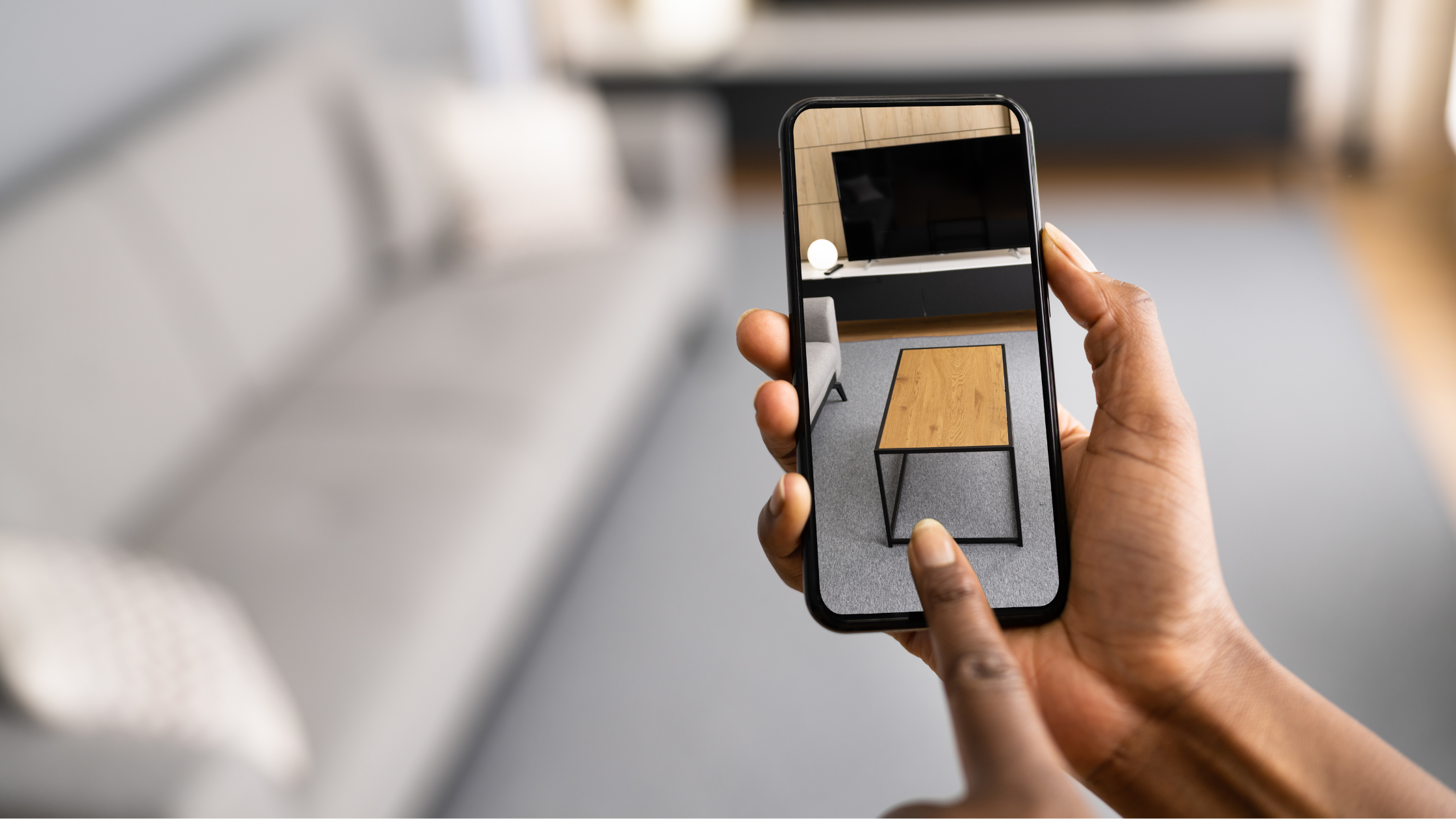
- Help customers visualize furniture in their homes
- Create virtual showrooms and interactive displays
- Deliver gamified brand experiences
And consumers responded.
According to research, more than 60% of consumers say they want brands to offer AR experiences, while products with 3D and AR content can see conversion rates up to 94% higher than products without them.
Retailers also discovered that immersive visualization helped reduce uncertainty in the buying process, lowering return rates in categories like furniture and apparel.
This first wave of AR innovation proved something important: Visualization changes customer confidence. It reduces uncertainty, increases purchase confidence, and helps customers make buying decisions with greater accuracy.
Retail strategists and visual merchandising experts were starting to see how immersive technologies could reshape the future of consumer experience through more engaging, immersive interactivity. AR and VR could create opportunities to bring products and environments to life in ways traditional merchandising never could.
Over time, retailers began to suspect that immersive technologies could solve much larger operational challenges, too.
Why Retailers Are Re-Evaluating AR and VR
Retail has become significantly more complex over the last several years. Stores now vary widely in layouts, fixtures, product assortments, staffing availability, and inventory conditions.
At the same time, customer expectations for consistent brand experiences have increased.
Retailers are expected to move faster, localize more effectively, and execute campaigns with precision across hundreds or thousands of locations.
That operational pressure is changing how retailers think about immersive technologies, like AR and VR. They’re considering how augmented and virtual reality can become operational systems.
The challenge used to be imagining the experience, which was solved by immersive shopping.
Now, the challenge is ensuring the experience shows up accurately at the store level, which offers potential for immersive retail execution.
AR Is Changing More Than the Customer Experience
One of the biggest misconceptions about augmented reality in retail is that it only impacts shoppers.
Increasingly, this immersive technology has proven successful in operational execution behind the scenes. AR-enabled workflows can help:
- Guide associates through merchandising tasks
- Visualize planogram placement directly on shelves
- Improve onboarding and training
- Reduce setup errors during resets
- Simplify execution guidance
- Improve compliance validation
This matters because execution has become one of retail’s biggest operational challenges.
Even the best-designed campaigns fail when field teams set products incorrectly, miss displays, put up outdated signage, ignore localized constraints, or struggle to interpret merchandising directives.
As store environments become more complex and labor resources become more constrained, retailers increasingly need execution workflows that are more visual, intuitive, and adaptable in real-world conditions.
Now: From Visualization to Validation
One of the biggest shifts in retail technology is the move from static visualization to connected execution workflows.
Retailers no longer want visualization tools that only show what one store could look like. They want systems that help ensure the experience actually happens across all locations.
That’s where AR, VR, AI, and digital store modeling are beginning to converge.
Modern retail organizations increasingly need connected workflows that allow them to:
- Visualize merchandising decisions in 3D
- Simulate store conditions before rollout
- Adapt plans to individual locations
- Communicate tasks clearly to field teams
- Validate what actually happened in-store
This is the next evolution of visual merchandising, not simply designing the right experience but ensuring the brand experience survives the journey from intent to reality.
2026 Reflection: What Retailers Got Right — and What’s Changed
Many of the early conversations around AR and VR correctly predicted where retail was heading:
- More immersive customer experiences
- Greater use of digital visualization
- Increased reliance on data and technology
- Faster retail cycles and higher customer expectations
What’s changed since then is the role immersive technologies now play operationally, not just commercially.
Immersive technologies are no longer being evaluated solely by how engaging they are for shoppers. Retailers increasingly measure them by how effectively they improve execution accuracy, reduce friction for field teams, accelerate rollout speed, and support more consistent in-store experiences.
The Bottom Line
The future of visual merchandising is a more connected retail workflow, one that closes the gap between strategy, execution, and the customer experience.
Because in retail, the brand is what customers actually experience in-store, and immersive technologies are helping to ensure those experiences show up consistently, accurately, and at scale.
Download the 2026 VR in Retail Guide to explore how leading retailers are using immersive technologies to improve execution, reduce friction, and deliver more consistent in-store experiences at scale.