The Paper Planogram Is Dead. What’s Next for Visual Merchandising?
For years, the paper planogram was the cornerstone of visual merchandising strategy, helping retailers map product placement, enforce brand consistency, and guide store execution across the entire network.
But let’s be honest: Paper planograms were revolutionary — in 1972.
A time before real-time data, store-specific assortments, and omnichannel shopping behaviors.
A time when printing thick binders of diagrams felt like innovation.
A time that’s long behind us.
Today, the traditional planogram isn’t just outdated — it’s holding you back.
It’s not an asset. It’s an obstacle.
Paper Planograms Can’t Keep Up with Modern Visual Merchandising
The planogram originated at Kmart in the 1970s as a way to create brand and product consistency across sprawling retail networks. It was a much-needed layer of structure and strategy.
And back then, it worked.
Store uniformity was the goal, and simple shelf diagrams were enough to get the job done.
But retail evolved fast.
Today’s visual merchandising teams are responsible for far more than symmetry. You’re expected to:
- Deliver localized, personalized shopping experiences
- Pivot quickly to meet consumer demand and product inventory
- Align merchandising with marketing campaigns
- Prove your visual merchandising strategy drives measurable results
And you’re expected to do all of this with leaner teams, tighter timelines, and more frequent resets.
You’re being asked to do more with less — and prove your impact while doing it.
But when outdated tools slow execution and cloud performance visibility, even the best strategy can fall flat.
Paper planograms, static PDFs, and disconnected systems can’t keep up.
Worse — they’re actively holding your team back and causing confusion; there’s no single source of truth.
What’s Wrong with Traditional Paper Planograms?
Let’s break it down:
- They aren’t store-specific. Most paper planograms assume uniform layouts and assortments. They don’t reflect the real conditions in your stores, creating a disconnect between the plan and what’s actually possible in-store.
- They’re hard to interpret. Store teams burn hours flipping through documents, decoding dense diagrams, or trying to guess what applies to their location. (Gen Z store associates prefer digital execution instructions, anyway.)
- They’re often out of date. Printouts get lost. Emails are missed. Resets change weekly. Teams often don’t know if they’re using the most up-to-date version.
- They create in-store execution gaps. Poor localization leads to empty pegs, overstocked shelves, missed sales, and unhappy customers.
- They leave no room for feedback. Most paper-based systems are one-way. Stores can’t flag issues or suggest workflow improvements, and HQ can’t measure compliance in real-time.
Simply put: The traditional paper planogram doesn’t reflect how modern retail works.
So, we built something that does…
Introducing the Digital Store Model
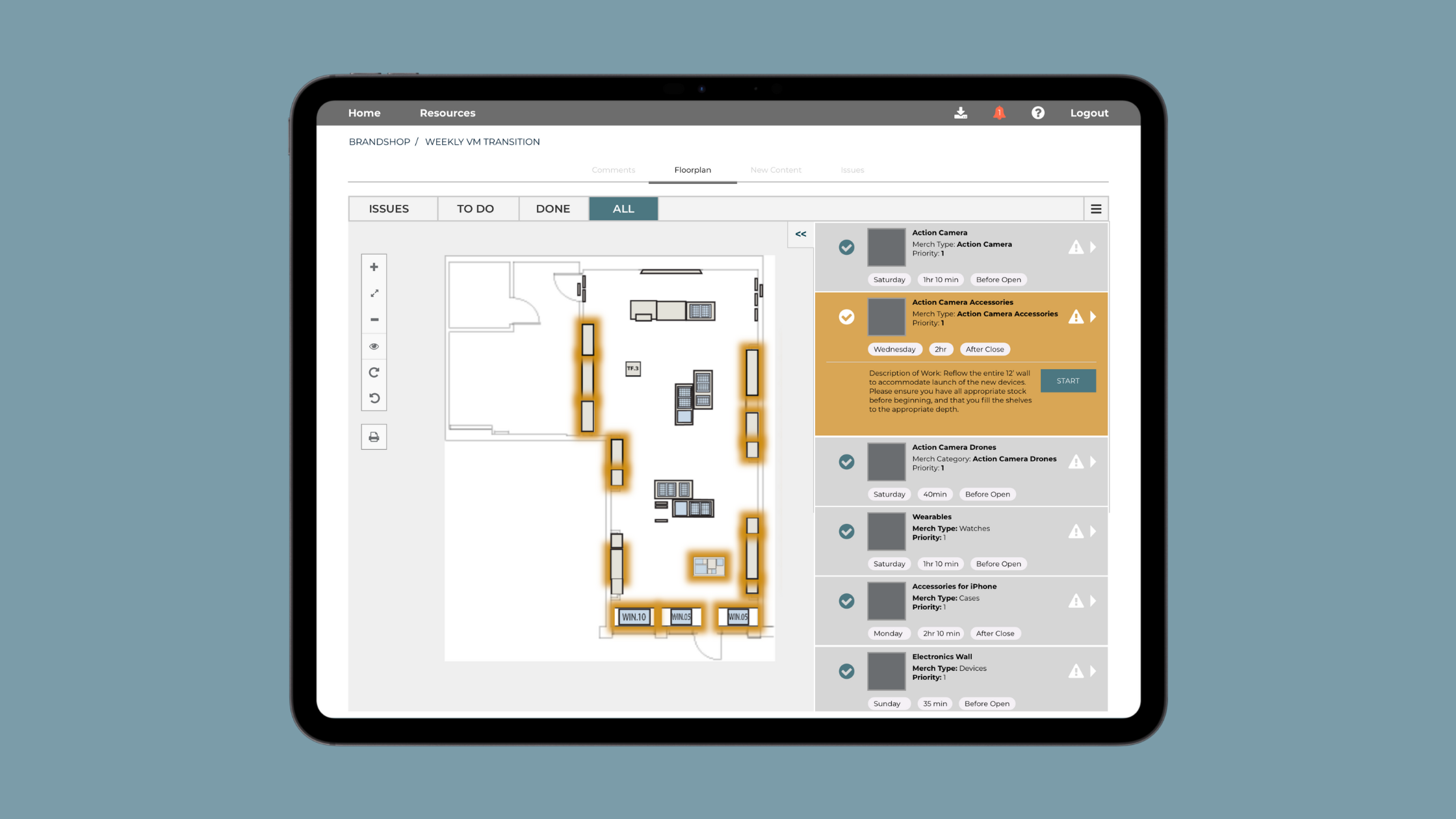
One Door’s Digital Store Model is a modern alternative to static planograms. It replaces outdated paper planograms with a living, data-rich digital twin of every store in your fleet.
This isn’t just a prettier PDF.
It’s a complete visual merchandising intelligence layer that captures individual store layouts, fixture data, sales performance, inventory levels, and more — all in real-time.
With the Digital Store Model, you can finally:
- Automatically localize merchandising plans based on real store conditions
- Deliver step-by-step digital instructions and eliminate manual errors
- Auto-calculate signage counts and fulfillment needs
- Track plan completion and compliance down to the SKU
- Enable precise store communication between HQ and store teams
This is precision merchandising made possible by modern planogram tools — built for the realities of today’s store teams, customers, and brand expectations.
Why Now?
Because the risks of staying static are too high.
Store teams are stretched. Customer expectations are rising.
Every delay, misfire, or miscommunication affects the bottom line.
Retailers that modernize their visual merchandising tech are better positioned to:
- Launch faster, more effective in-store campaigns
- Improve execution quality across regions
- Reduce print waste and improve fulfillment accuracy
- Link visual merchandising to sales with real-time Store Insights
- Track store compliance
The sooner you digitize, the faster you can drive executional excellence where it matters most — in-store.
Ready to Leave Static Planograms Behind?
Visual merchandising isn’t just about setting shelves. It’s about influencing what sells.
With One Door’s Digital Store Model, you can:
- Replace guesswork with localized, data-driven planning
- Replace confusion with clear digital guidance
- Replace static diagrams with living, real-time store layouts
The Digital Store Model gives visual merchandisers a modern toolkit for precise store planning, localized execution, and strategic decision-making — all in one merchandising platform.
So, yes, the planogram is dead.
But what comes next is smarter, faster, and finally built for how today’s retail really works.
Start with our Dynamic Planogram Guide to learn how to evolve your strategy beyond paper.
Or, request a demo to see how One Door’s Digital Store Model can transform your planning and in-store execution.