Extended Reality in Retail: How VR, AR, and MR Are Transforming Store Planning and Execution
As retailers move beyond static planning and execution processes, Extended Reality (XR) is emerging as a more practical way to design, test, and experience stores.
This guide breaks down what XR means for retail, how it’s being used today, and why it’s becoming a foundational tool for modern store planning and execution.
What is Extended Reality?
Extended Reality is an umbrella term for immersive technologies that blend the physical and digital world. Rather than treating it as a single technology, Extended Reality is best understood as a spectrum that includes Virtual Reality (VR), Augmented Reality (AR), and Mixed Reality (MR).
How Does XR Help Retailers?
Extended Reality enables retail teams to move beyond flat visuals and experience stores, shelves, and displays in interactive, lifelike environments that teams can explore and refine using VR, AR, and MR.
Virtual Reality in Retail
We wrote an overview about how virtual reality is used in retail, but here’s a good refresher: Virtual Reality creates fully immersive, computer-generated 3D environments that replicate real-world stores to help brands and retailers:
- Step inside life-size store labs to experience layouts from a shopper’s perspective
- Evaluate shelf configurations and planograms from true shopper sightlines and physical scale
- Conduct immersive shopper studies within simulated stores that mirror real browsing and buying behavior
- Practice store operations through hands-on, scenario-based VR simulations
Within the broader XR spectrum, VR is the most immersive tool. It gives retail teams a full end-to-end way to test ideas, validate decisions, and experience stores exactly as they will exist in the real world.
Augmented Reality in Retail
Augmented Reality overlays digital information onto real store elements, typically through mobile devices or smart displays. AR is often shopper-facing, helping bridge digital and physical experiences at the point of engagement through:
- Virtual product try-ons
- In-store navigation or wayfinding overlays
- Enhanced product information layered onto shelves or displays
Across the XR spectrum, AR is immediate and accessible. It enhances real-world environments with digital information. This helps retailers close the gap between plans and reality at the moment of interaction without fully replacing the physical store.
Explore more AR applications from today’s top retailers in our 2025 Guide to Retail, Visual Merchandising, and AI Trends.
Mixed Reality in Retail
Mixed Reality represents a deeper fusion of physical and digital environments. Where AR overlays digital information onto store elements, MR enables digital elements to remain anchored to fixtures, shelves, or products. They also change dynamically as shoppers move through the store.
Because the digital content understands and interacts with physical space in real time, MR creates experiences that feel less like layered visuals and more like a single, blended space. In retail, Mixed Reality can support:
- Interactive product demonstrations that respond to physical movement or touch
- Guided in-store experiences that adapt based on shopper location, behavior, or engagement
- Collaborative design and review sessions where teams interact with digital concepts mapped directly onto physical store elements
While MR adoption in retail is still evolving, it represents the next step in XR, one where digital intelligence and physical environments operate together as a unified system, rather than existing as separate layers.
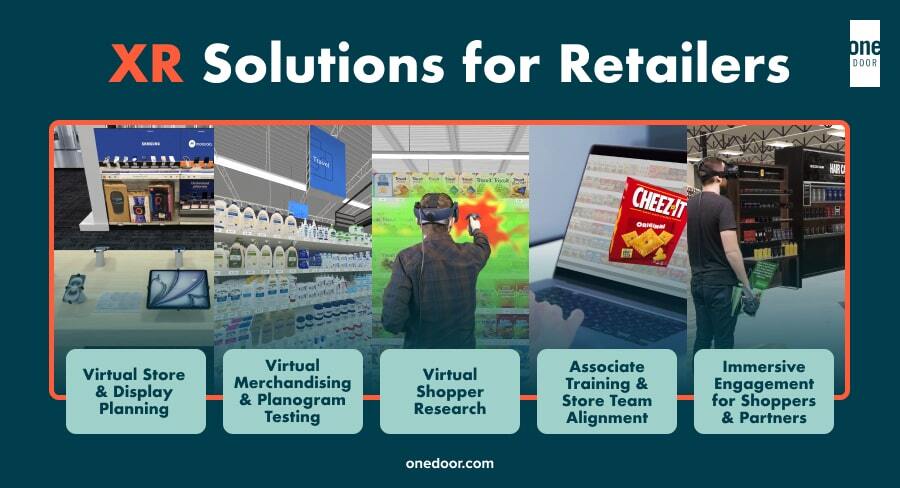
XR Solutions for Retailers
XR’s value is in how it solves everyday retail challenges, from planning and testing to training and execution. Extended Reality turns complex decisions into experiences teams can see, test, and trust before anything goes live.
Virtual Store & Display Planning
XR enables retailers and brands to design, explore, and refine stores and displays using a combination of immersive and contextual digital tools.
Instead of relying on flat plans or single-mode visualization, teams can move fluidly between 3D, VR, and on-screen experiences to test ideas before execution:
- Prototype layouts digitally without building physical mockups
- Compare multiple merchandising scenarios across formats and store types
- Validate sightlines, adjacencies, and shopper flow using immersive and desktop views
By combining immersive depth with flexible access, XR reduces costly rework, accelerates alignment, and makes early-stage planning more collaborative and confident.
Virtual Merchandising & Planogram Testing
XR turns planograms into interactive spatial experiences that reflect how shelves perform in the real world. Rather than treating planograms as static documents, XR allows teams to explore, adjust, and validate POGs using immersive and screen-based environments:
- Contextually visualize assortments across different store formats
- Dynamically optimize SKU placement, blocking, and hierarchy
- Ensure merchandising intent translates clearly from strategy to shelf
This XR-driven approach closes the gap between planning and execution by making planograms easier to understand, evaluate, and act on before rollout.
Virtual Shopper Research
XR-powered market research combines immersive simulation with digital data capture. Retailers and brands can study behavior inside realistic life-size store environments or maintain the speed and flexibility of online research with interactive shelf experiences:
- Observe navigation paths and dwell time in lifelike store simulations
- Measure attention using eye tracking, click behavior, or interaction data
- Test layouts, signage, pricing, or packaging earlier in the planning cycle
By blending realism with scalability, Extended Reality delivers shopper insights faster and earlier than traditional methods, reducing risk while improving decision quality.
Associate Training & Store Team Alignment
XR provides a more effective way to train teams on new products and merchandising strategies with interactive aisle experiences. Instead of relying on passive training documents, associates can learn by stepping into the virtual aisle to:
- Explore shelves and displays in a realistic store environment
- Examine products up close to understand features and benefits
- Learn new visual merchandising layouts before they’re live in-store
Training associates in a virtual aisle helps identify issues earlier, improve speed-to-market time, and execute launches with fewer last-minute changes.
Immersive Engagement for External Partners
XR plays a critical role in how retail teams communicate ideas and engage audiences. By combining immersive visualization with accessible digital experiences, XR-enabled engagement helps bring store strategies to life for external partners through:
- Virtual store walkthroughs that support line reviews and partner alignment
- Interactive product visualization that helps shoppers understand fit, scale, or placement
- Experiential brand moments that translate product benefits into memorable experiences
These Extended Reality experiences reduce ambiguity and strengthen understanding. They show not just what is being sold, but how it comes to life in real stores.
Real-World XR Examples in Retail
While XR may sound conceptual, leading retailers and brands are already using it to solve real, everyday challenges. These examples show how XR moves from theory to tangible impact inside physical retail environments:
- Clorox used VR to design and test a cleaning aisle, leveraging eye tracking to understand how shoppers engaged with sustainability messaging and product placement. This improved display performance against competitors.
- L’Oréal uses AR-powered virtual try-ons to let shoppers test makeup digitally, increasing confidence and reducing friction in the path to purchase.
- MUJI introduced in-store VR experiences that immersed shoppers in calming environments while interacting with products. This reinforced brand values through experience rather than messaging alone.
Why XR Is Becoming Essential for Retail Teams
Extended Reality represents a shift from static planning to experiential decision-making. It supports the development of immersive, connected experiences that reflect how stores actually function and how shoppers expect them to perform.
As retail environments grow more complex and shopper expectations rise, Extended Reality is becoming a practical foundation for designing, testing, and executing better in-store experiences.